
Transforming ordinary travel snapshots into breathtaking landscape photographs requires more than just pointing your camera and shooting. It’s about understanding light, composition, and the art of capturing a scene’s essence. This guide delves into the practical techniques and planning strategies that will elevate your travel photography, turning your journeys into stunning visual narratives.
From meticulously planning your itinerary to masterfully editing your images, we’ll cover every aspect, from choosing the right gear and mastering composition techniques to navigating travel logistics and understanding legal considerations. We’ll explore diverse locations, from the rugged beauty of the Scottish Highlands to the vibrant energy of urban escapes, providing actionable tips and inspiring examples along the way.
Planning Your Landscape Photography Trip
Successful landscape photography hinges significantly on meticulous pre-trip planning. Thorough preparation ensures you maximize your time in the field, optimize shooting conditions, and ultimately capture the breathtaking images you envision. This involves strategically designing your itinerary, packing the right gear, and understanding the environmental factors that will influence your photography.
Sample Seven-Day Scottish Highlands Landscape Photography Itinerary
A well-structured itinerary is crucial for efficient shooting. This sample itinerary focuses on maximizing daylight hours and accessing diverse landscapes. Remember that weather in the Highlands is unpredictable, so flexibility is key.
- Day 1: Arrival in Inverness & Loch Ness Exploration (Afternoon/Evening): Arrive at Inverness Airport (INV), collect your rental car, and drive to a base near Loch Ness. Spend the afternoon exploring Urquhart Castle for dramatic castle ruins against the loch, aiming for the golden hour (around an hour before sunset) for optimal lighting.
- Day 2: Cairngorms National Park (Full Day): Drive into the Cairngorms National Park, focusing on the area around Loch Morlich or Glen Feshie. Capture the vastness of the mountains and the beauty of the lochs. Consider early morning light for mist and dramatic cloud formations, and late afternoon light for warm tones on the hillsides.
- Day 3: Isle of Skye – Fairy Pools & Old Man of Storr (Full Day): Drive to the Isle of Skye, a breathtaking island with diverse landscapes. Visit the Fairy Pools for their vibrant colors and unique rock formations, aiming for midday light for optimal clarity in the water. In the afternoon, photograph the iconic Old Man of Storr rock formation, considering the late afternoon light for a dramatic silhouette against the sky.
- Day 4: Isle of Skye – Quiraing & Kilt Rock (Full Day): Explore the Quiraing, a stunning landscape with unique rock formations, and Kilt Rock, a dramatic cliff face resembling a kilt. Consider early morning light to capture the mist clinging to the hillsides and dramatic cloud formations. The late afternoon light can produce warm tones on the rock formations.
- Day 5: Eilean Donan Castle & Loch Duich (Morning/Afternoon): Visit the iconic Eilean Donan Castle, beautifully situated at the meeting point of three sea lochs. Aim for morning light to avoid harsh shadows and capture the castle’s reflection in the water. Spend the afternoon exploring the scenic Loch Duich.
- Day 6: Glencoe & Rannoch Moor (Full Day): Drive south towards Glencoe, a dramatic valley with a rich history. Capture the imposing mountains and the valley’s unique character. Continue to Rannoch Moor, a vast, desolate moorland offering unique photographic opportunities. Aim for golden hour lighting in both locations.
- Day 7: Departure from Inverness: Enjoy a final scenic drive back to Inverness Airport for your departure. Consider stopping at any locations you may have missed or wish to revisit for additional photography opportunities.
Landscape Photography Packing List
Packing the right gear is essential for success. This list prioritizes versatility and resilience to the unpredictable Scottish weather.
- Camera Body and Lenses: A full-frame camera is recommended for optimal image quality and low-light performance. Consider lenses ranging from a wide-angle (16-35mm) for expansive landscapes to a telephoto (70-200mm) for details and wildlife.
- Tripod: Essential for sharp images in low light and long exposures. Choose a sturdy and lightweight tripod suitable for varied terrain.
- Filters: A polarizing filter reduces glare and enhances color saturation, while a graduated neutral density filter balances exposure in high-contrast scenes. Consider a neutral density filter for long exposures.
- Remote Shutter Release: Minimizes camera shake during long exposures.
- Extra Batteries and Memory Cards: Always carry spares to avoid missing opportunities.
- Clothing: Layers are crucial. Pack waterproof and windproof outerwear, warm fleece layers, quick-drying base layers, and sturdy hiking boots.
- Other Essentials: Headlamp, backpack, first-aid kit, map, compass, sunscreen, insect repellent.
Researching Weather Patterns and Light Conditions
Understanding weather and light conditions is paramount. The Scottish Highlands are known for their changeable weather. Websites and apps providing detailed weather forecasts, such as the Met Office website, are invaluable. Planning your shooting schedule around predicted weather patterns and optimal light conditions (golden hour, blue hour) will significantly increase your chances of capturing stunning images. For instance, mist and fog can add a dramatic atmosphere, while clear skies provide opportunities for vibrant colors and sharp details.
Conversely, heavy rain may require you to alter your plans or seek shelter, whilst strong winds could impact the stability of your tripod. Using resources like photopills app can help predict the golden and blue hours, allowing you to optimize your shooting times.
Mastering Composition and Techniques
Creating stunning landscape photographs relies heavily on understanding and applying effective composition techniques. Mastering these techniques allows you to transform a simple scene into a captivating image that evokes emotion and tells a story. This section explores key compositional rules and practical techniques for enhancing your landscape photography.
Compositional Techniques: Rule of Thirds, Leading Lines, and Symmetry
Effective composition guides the viewer’s eye through the image, creating a sense of balance and visual harmony. Three fundamental compositional techniques frequently employed in landscape photography are the rule of thirds, leading lines, and symmetry. Each offers a unique approach to structuring your image and emphasizing key elements.The rule of thirds suggests placing key elements along imaginary lines that divide the frame into thirds both horizontally and vertically.
Instead of centering the subject, placing it at the intersection of these lines creates a more dynamic and visually appealing composition. For example, imagine a majestic mountain range. Instead of placing it dead center, positioning it along one of the horizontal thirds, with perhaps a foreground element like a lone tree on the lower third, adds depth and visual interest.Leading lines, on the other hand, use natural elements such as roads, rivers, or fences to guide the viewer’s gaze deeper into the scene.
These lines create a sense of depth and perspective, drawing the eye towards the main subject or focal point. A winding road disappearing into a distant valley, for instance, effectively uses leading lines to enhance the image’s depth and narrative.Symmetry, in contrast to the rule of thirds and leading lines, relies on creating a balanced and mirror-like composition.
This approach works best with scenes that possess inherent symmetry, such as a perfectly reflected lake or a symmetrical building. A photograph of a calm lake reflecting a mountain range, with the reflection perfectly mirroring the mountain, is a prime example of symmetrical composition. The effect is one of stillness and tranquility.
Capturing Stunning Sunsets and Sunrises
Sunsets and sunrises offer unparalleled opportunities for dramatic landscape photography. However, capturing their vibrant colors and dynamic light requires careful consideration of exposure settings and the use of filters.Optimal exposure is crucial. The high dynamic range of these scenes, with both bright highlights and dark shadows, often necessitates using techniques like bracketing (taking multiple shots at different exposures) to capture the full range of tones.
This allows for merging the exposures later in post-processing software to recover detail in both highlights and shadows. Proper white balance is also essential to ensure accurate color representation. Shooting in RAW format provides greater flexibility for adjustments during post-processing.Filters can significantly enhance the quality of your sunset and sunrise images. A graduated neutral density (GND) filter is particularly useful for balancing the exposure between the bright sky and the darker foreground.
A polarizing filter can help reduce glare and enhance color saturation, resulting in richer, more vibrant colors. A circular polarizer is generally preferred for its convenience and versatility.
Utilizing Foreground Elements to Enhance Depth and Visual Interest
Foreground elements play a critical role in enhancing the depth and visual interest of landscape photographs. By including a compelling foreground, you create a sense of scale, add visual layers, and draw the viewer’s eye into the scene.A strong foreground element can act as a visual anchor, grounding the viewer and providing a sense of scale to the landscape beyond.
This could be anything from wildflowers in the immediate foreground to a rocky outcrop or a body of water. The choice of foreground element depends on the overall composition and the message you want to convey. For example, a foreground of textured rocks can lead the viewer’s eye towards a distant mountain range, creating a clear visual pathway through the image.
The inclusion of a foreground element provides context and depth, making the overall image more engaging and immersive.
Essential Gear and Equipment
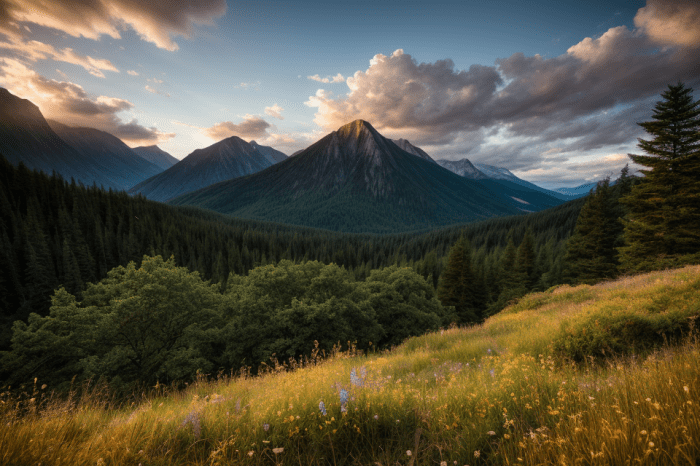
Choosing the right gear is crucial for capturing stunning landscape photographs. The equipment you select will significantly impact the quality of your images and your overall experience in the field. While advanced equipment can be beneficial, a well-chosen basic setup can still produce exceptional results. Focusing on quality over quantity is often a more effective strategy, especially when starting out.
The following table Artikels essential equipment categories and examples within each. Remember that your specific needs may vary depending on your shooting style and preferences.
Camera Body and Lenses
| Camera Body | Lenses | Accessories | Other |
|---|---|---|---|
| High-resolution DSLR or Mirrorless camera (full-frame sensor preferred for low-light performance) | Wide-angle lens (14-24mm): Captures expansive landscapes. Telephoto lens (70-200mm or longer): Isolates details and compresses perspective. Standard zoom lens (24-70mm): Versatile option for various shooting situations. |
Sturdy tripod: Essential for sharp images, especially in low light. Remote shutter release: Minimizes camera shake. Camera bag: Protects your equipment. |
Cleaning kit: For maintaining lens and sensor cleanliness. Extra batteries: Ensuring you don’t miss a shot. Memory cards: Sufficient storage capacity. |
Lens Types and Their Applications
Different lenses offer unique perspectives and capabilities for landscape photography. Understanding their strengths and weaknesses is vital for making informed choices.
Wide-angle lenses (typically below 35mm) excel at capturing expansive scenes, emphasizing the vastness of a landscape. They can, however, distort straight lines near the edges of the frame, a phenomenon known as barrel distortion. This distortion can be minimized through careful composition and post-processing techniques. Examples include the stunning vistas of a mountain range or a panoramic ocean view, where the wide angle lens captures the full scale and grandeur of the scene.
Telephoto lenses (typically above 70mm) compress perspective, making distant objects appear closer and larger. This is useful for isolating elements within a broader landscape, drawing the viewer’s eye to specific details. They also offer excellent reach for capturing wildlife within the landscape context. Imagine a lone tree on a distant hill, a telephoto lens can beautifully isolate and highlight it against the expansive background.
Standard zoom lenses (typically 24-70mm) provide a versatile range, suitable for a variety of compositions. They offer a balance between wide-angle and telephoto perspectives, allowing for adaptability in different shooting scenarios. This versatility is particularly beneficial for photographers who prefer a lighter and more compact kit.
Using Filters to Enhance Landscape Images
Filters are invaluable tools for improving the quality and creative impact of landscape photographs. They allow for greater control over light and contrast, leading to more dynamic and visually appealing images.
Neutral Density (ND) filters reduce the amount of light entering the lens, allowing for slower shutter speeds. This is particularly useful for creating silky smooth water effects or blurring motion in other elements of the scene, such as clouds. For example, a long exposure with an ND filter can transform a rushing waterfall into a flowing veil of white, enhancing its ethereal beauty.
Polarizing filters reduce glare and reflections, enhancing color saturation and contrast. They are particularly effective in reducing reflections on water surfaces or enhancing the blue of the sky. A polarizer can significantly improve the clarity and vibrancy of a landscape image shot on a sunny day, especially when shooting near water bodies or reflective surfaces.
Graduated Neutral Density (GND) filters gradually darken a portion of the image, balancing exposure between bright skies and darker foregrounds. This is especially helpful when shooting scenes with a high dynamic range, preventing overexposure in the sky and underexposure in the foreground. For example, a sunset scene with a bright sky and a darker landscape can benefit greatly from a GND filter, ensuring both areas are properly exposed and detailed.
Post-Processing and Editing
Post-processing is the crucial final step in creating stunning landscape photographs. It allows you to refine your images, correcting imperfections and enhancing their visual impact to truly reflect the scene’s beauty as you envisioned it. While the foundation is laid in the field, post-processing elevates the image from a good snapshot to a captivating piece of art. This involves careful adjustments to various aspects of the image, from color and contrast to sharpness and overall tone.
A well-defined workflow is essential for efficient and consistent editing. This generally involves importing your images, making initial adjustments, and then fine-tuning for the desired effect. Different software packages offer various tools, but the core principles remain the same. The key is to understand how each adjustment affects the overall image and to develop a personal style that reflects your artistic vision.
A Step-by-Step Editing Process in Lightroom
This example Artikels a typical workflow using Adobe Lightroom, a popular choice for landscape photographers. The process can be adapted to other software like Photoshop, but the fundamental steps remain similar.
First, import your images into Lightroom. Organize them into folders or collections for easy access. Then, begin by making global adjustments. This typically involves correcting the white balance to ensure accurate colors, adjusting exposure to balance highlights and shadows, and setting contrast to enhance the dynamic range of the image. Next, address local adjustments using tools like the radial filter or graduated filter to selectively enhance or correct specific areas of the image.
Finally, fine-tune the sharpening and noise reduction, paying close attention to preserving detail while minimizing artifacts. Export the image at a high resolution for printing or online use.
Enhancing Colors, Contrast, and Sharpness
Enhancing these elements is critical for a striking landscape. Color adjustments can be subtle or dramatic, depending on your vision. For example, boosting saturation might intensify the blues of a sky or the greens of a forest. However, avoid over-saturation, which can lead to unnatural and unrealistic results. Contrast adjustments can help separate elements within the image and make the subject stand out.
Careful use of curves or split toning can provide a more nuanced control over contrast. Sharpening enhances detail, but overuse can lead to a harsh or unnatural look. Aim for a subtle sharpening that enhances the image without introducing artifacts.
Creating a Consistent Editing Style
Consistency is key to building a strong portfolio. Develop a personal style by experimenting with different editing techniques and identifying what works best for your images and vision. Consider factors such as color palettes, contrast levels, and overall mood. This consistency helps viewers easily recognize your work and appreciate your unique artistic perspective. Maintain a style guide for your editing process, documenting your preferred settings and techniques to ensure consistency across your entire portfolio.
This might involve using presets or developing your own custom profiles. Reviewing your past work and identifying common threads in your editing choices will help you refine your style and ensure uniformity.
Travel Hacks and Tips
Successfully capturing stunning landscapes relies not only on photographic skill but also on efficient and cost-effective travel planning. This section will provide practical tips and strategies to streamline your journey and maximize your time spent shooting, ultimately enhancing your landscape photography experience.
Careful planning is key to a successful photography trip. By implementing smart strategies, you can significantly reduce expenses and optimize your time, leaving you more focused on capturing breathtaking images.
Money-Saving and Time-Saving Travel Hacks
Several strategies can help you save both money and time while traveling for photography. These range from booking flights strategically to utilizing free resources available to photographers.
- Travel during the shoulder season: Avoid peak tourist seasons for lower flight and accommodation costs, and fewer crowds at popular locations.
- Utilize budget airlines and consider alternative airports: Sometimes flying into a smaller, less popular airport can significantly reduce airfare.
- Book accommodations in advance, but remain flexible: Booking early often secures better rates, but be prepared to adjust your plans if better deals appear.
- Pack light: Avoid checked baggage fees by carefully curating your gear and clothing to fit within carry-on limits. This also saves time at the airport.
- Take advantage of free resources: Many cities offer free walking tours or public transportation options, saving money on guided tours and taxis.
- Look for free Wi-Fi: Avoid expensive roaming charges by utilizing free Wi-Fi hotspots at cafes, libraries, or hotels.
- Prepare meals and snacks: Eating out for every meal can quickly add up. Preparing some meals or snacks in advance can significantly reduce food costs.
The Importance of Travel Insurance
Travel insurance is a crucial aspect of any photography trip, particularly international ones. It provides financial protection against unforeseen circumstances that could disrupt your plans or lead to significant expenses.
A comprehensive travel insurance policy should cover medical emergencies, trip cancellations, lost or stolen equipment, and baggage loss or damage. Consider policies that specifically cover expensive photographic equipment. Carefully review the policy details, including exclusions and limitations, before purchasing.
For example, a photographer whose camera is stolen would be financially protected by a policy covering lost or stolen equipment, allowing for replacement or repair costs to be covered. Similarly, a medical emergency in a foreign country could result in substantial medical bills, which a comprehensive travel insurance policy would help alleviate.
Essential Travel Documents and Items for International Travel
Having all necessary documents and items organized before your trip is crucial for a smooth and stress-free experience. This checklist ensures you are prepared for any eventuality.
- Passport and Visas: Ensure your passport is valid for at least six months beyond your travel dates and obtain any necessary visas well in advance.
- Flight and Accommodation confirmations: Keep both physical and digital copies readily available.
- Travel insurance policy details: Including contact information for your insurer.
- Copies of important documents: Keep separate copies of your passport, visas, and other crucial documents in a secure location, away from your originals.
- Credit cards and cash: Inform your bank of your travel dates to avoid any issues with card usage abroad.
- International driving permit (if needed): If you plan to rent a car.
- Basic first-aid kit: Including any personal medications.
- Adapters and converters: For your electronic devices.
Travel Visa and Legal Considerations
Planning a landscape photography trip often involves navigating international borders and understanding the legal frameworks surrounding photography in different locations. Overlooking these aspects can lead to significant delays, fines, or even legal trouble. This section addresses the essential travel visas and legal considerations to ensure a smooth and legally compliant photography adventure.
Successfully capturing stunning landscapes relies not only on photographic skill but also on meticulous planning and adherence to local laws. This includes understanding visa requirements, respecting property rights, and obtaining necessary permits for shooting in protected areas. Failing to do so can significantly impact your trip and potentially lead to legal repercussions.
Visa Requirements and Documentation
Securing the appropriate visa is paramount before embarking on any international photography trip. Visa requirements vary drastically depending on your nationality and your destination. For instance, citizens of the United States may require a Schengen visa for travel within the European Union, while those from Canada might need a specific visa for entry into certain Asian countries. It’s crucial to check the visa requirements well in advance of your trip, as the application process can be time-consuming.
Always confirm the specific requirements on the official website of the country’s embassy or consulate in your home country. Thorough preparation includes gathering necessary supporting documentation, such as proof of travel insurance, itinerary, and financial statements. Failure to provide the correct documentation can lead to visa rejection.
Legal Aspects of Photographing in Public and Private Spaces
Photographing in public spaces generally enjoys greater freedom than in private spaces. However, even in public areas, there can be restrictions. For example, photographing sensitive infrastructure, such as military bases or government buildings, might be prohibited. In private spaces, permission from the property owner is almost always required. This applies to photographing buildings, homes, and even individuals on private land.
Taking photographs without consent can lead to legal issues, including lawsuits for invasion of privacy or copyright infringement. It’s always best to err on the side of caution and obtain explicit permission before photographing individuals or private property.
Obtaining Permits for Protected Areas and National Parks
Many national parks and protected areas require permits for photography, especially for commercial purposes or activities involving drones. These permits often involve fees and may include specific guidelines on where and how you can photograph. For example, Yellowstone National Park in the USA has specific regulations concerning drone use and photography in sensitive areas. The application process varies depending on the location, but typically involves submitting an application form well in advance of your trip.
Failure to obtain the necessary permits can result in fines and the confiscation of your equipment. It’s recommended to contact the park authorities directly to understand their specific permit requirements and application procedures.
Venture Capital and Photography Businesses (Optional – tangential but relevant to monetization)
The intersection of venture capital and photography businesses presents a unique landscape of opportunity and challenge. While traditionally viewed as a creative pursuit, photography is increasingly becoming a data-driven industry, attracting investors who see potential for scalability and high returns. The digital age has opened doors for innovative business models, transforming how photographers operate and monetize their work.Venture capital investment in photography-related businesses is driven by several factors.
The growing demand for high-quality visual content across various sectors, including advertising, media, and e-commerce, fuels the need for sophisticated photography services and technologies. Furthermore, the increasing adoption of AI and machine learning in image processing and management creates opportunities for startups developing cutting-edge tools and platforms. This technological advancement coupled with the ever-expanding online market creates a fertile ground for investment.
Successful Photography Businesses with Venture Capital Funding
Several photography-related businesses have successfully secured venture capital funding, demonstrating the viability of this sector. While specific funding amounts and details are often confidential, successful examples often involve businesses that go beyond traditional photography services and integrate technology or leverage strong business models. For instance, a company specializing in AI-powered image enhancement or a platform connecting photographers with clients globally could attract significant investment.
These businesses typically showcase a clear path to profitability, a strong management team, and a large addressable market. The success stories often involve innovative technology, a scalable business model, and a strong team capable of execution.
Challenges and Opportunities in Securing Venture Capital
Securing venture capital for a photography-based startup presents unique challenges. Investors often seek businesses with demonstrable scalability and a clear path to high returns. Convincing investors of the long-term potential and financial viability of a photography business can require a strong business plan and a compelling narrative. The inherent creativity of photography can sometimes be perceived as a barrier to standardization and scalability, requiring entrepreneurs to demonstrate how their business model can overcome this.
However, the opportunities are significant. The increasing demand for high-quality visual content, the rise of new technologies, and the potential for global reach through online platforms present a compelling case for investment. A well-structured business plan that clearly articulates the value proposition, target market, and revenue model is crucial in securing funding. Demonstrating a strong understanding of the market dynamics, competitive landscape, and financial projections is essential.
Moreover, showcasing a robust team with relevant experience in both photography and business management significantly enhances the chances of securing investment.
Mastering landscape travel photography is a journey of continuous learning and creative exploration. By combining careful planning, technical proficiency, and a keen eye for detail, you can transform your travel experiences into captivating visual stories. Remember, the most stunning landscapes are not just found in far-off destinations, but also in the ability to see the extraordinary in the ordinary. Embrace the adventure, experiment with different techniques, and most importantly, enjoy the process of capturing the world’s beauty through your lens.
Expert Answers
What camera settings should I use for landscape photography?
Generally, use a low ISO (e.g., 100-400) for minimal noise, a narrow aperture (e.g., f/8-f/16) for sharp focus from foreground to background, and a shutter speed appropriate for the light conditions (use a tripod for slower speeds).
How do I avoid overexposed skies in my landscape photos?
Use a graduated neutral density (GND) filter to darken the sky while maintaining detail in the foreground. Alternatively, you can expose for the highlights and recover shadow detail in post-processing, but this may result in some noise.
What’s the best time of day to shoot landscapes?
The “golden hour” (sunrise and sunset) offers soft, warm light that is ideal for landscape photography. The “blue hour” (twilight) provides a cool, moody atmosphere.
How important is post-processing in landscape photography?
Post-processing is crucial for enhancing the final image. It allows you to adjust exposure, contrast, color, and sharpness, and correct any imperfections. However, avoid over-processing, which can make the image look unnatural.


